Tuesday, March 21, 2023
Why you may ask are we still in Why even though the plan for today was to move further East. Well the why would be the wind came howling in before we got up this morning. Still hoping while Tom made coffee I checked the weather and there it was a wind advisory. As I read I saw were it mentioned the possibility of strong cross winds on AZ-86 which would have been our route today. Sustained winds of 20 to 25mph with gusts of 40 to 45mph is not the weather we travel in. It would need to be an emergency for us to do so. Since, we have the advantage of being retired without a set schedule we went to Plan B, leave Tuesday.
Tom decided to take care of a couple of things inside today. While he was busy I took a ride over to Olson's IGA to pick up a few things, stopped and took a few pictures along the way, and made a quick stop at the Thrift Store. The Thrift store did have a nice variety of items but nothing I needed to give up something else for. That space thing, one item in one out...lol
 |
| Pulling out of our spot I could see the dust in the distance/ |
 |
| One thing about wind is the flag does fly beautifully. |
 |
| More dust in the distance. |
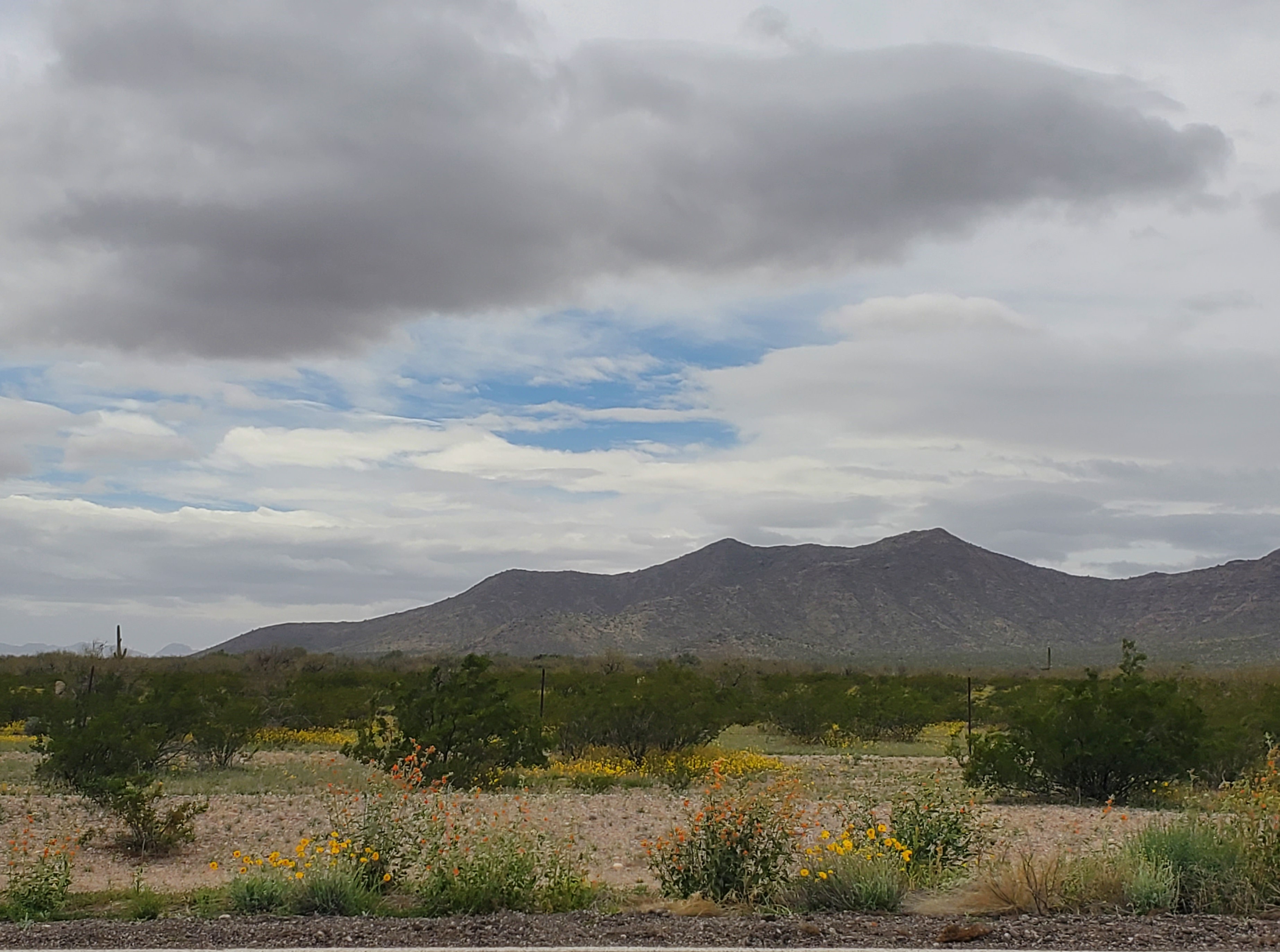 |
| The only blue sky I saw today; the sun did not make an appearance. There is yellow on the ground though. |
 |
| Just before you get to Ajo going north you pass by these hills of tailings from the New Cornelia Mine. |
 |
| I know they are mine tailings but from the first time we came this way I have found the colors coming down to be beautiful. |
 |
| The colors are certainly more vivid when the sun is shining and I have taken and posted several similar pictures in past posts. |
 |
| Yet even today with the dark clouds the colors stood out. |
 |
| So even though I have several pictures of these hills of |
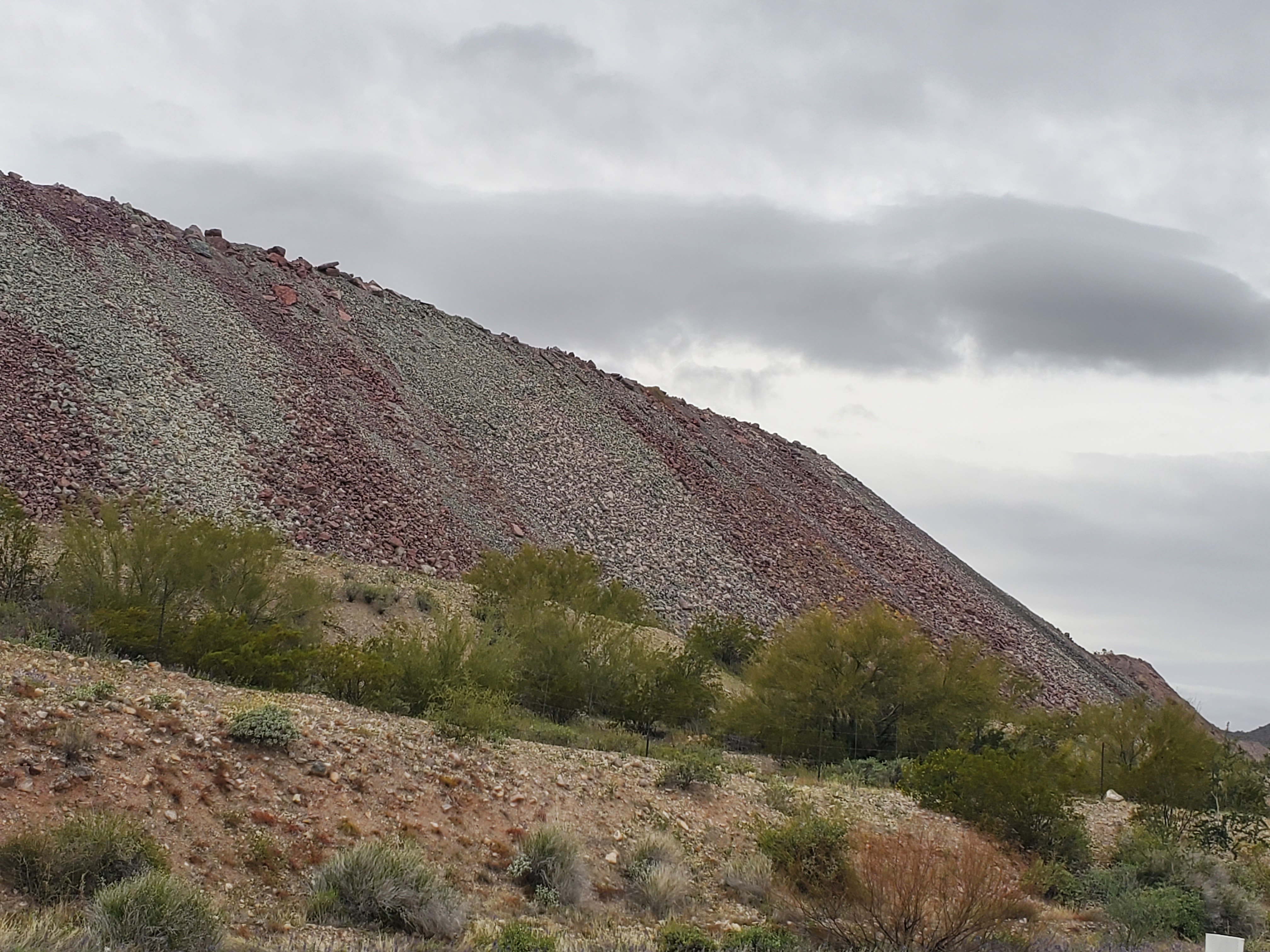 |
| tailings I clicked away to add several more. |
 |
| I have tried several times to get this mural with the door shut, bottom right, today I succeeded. |
 |
| Across the street I saw this one and I do not remember seeing it in the past. |
 |
| Heading home the wind was still blowing and the dust could still be seen in the distance. There are mountains across the entire horizon in the distance. |
As I write this the wind is still howling as it has all day and looking at the weather it will be with us most of the night. It also looks like we may get rain but if the weather predictors are correct by the time we are ready to pull out in the morning the rain will be done and the wind will just be a breeze. We are hoping they are right.
Saturday, March 18, 2023 (South Puerto Blanco Drive--Senita Basin)
Leaving the Ajo Mountain Drive we turned left/south on AZ-85 to the South Puerto Blanco Drive. From there we turned onto the road that would take us to the Senita Basin. Which is where there are Senita Cactus but we found very few and the ones we did see did not look healthy. What we did see were a lot of Saguaros. Saguaros of so many different sizes and shapes and that was not a disappointment.


 |
| The blue flag is to let you know there is a water barrel there. |
 |
| This looked like what we have seen in the desert in the past. If you are in trouble you can signal for help. |
 |
| Senita |

 |
| Those mountains are in Mexico. |

 |
| We could see vehicles and buildings on the other side of the fence. |

 |
| Leaving South Puerto Blanco Drive we have turned North and are headed home on AZ-85 |

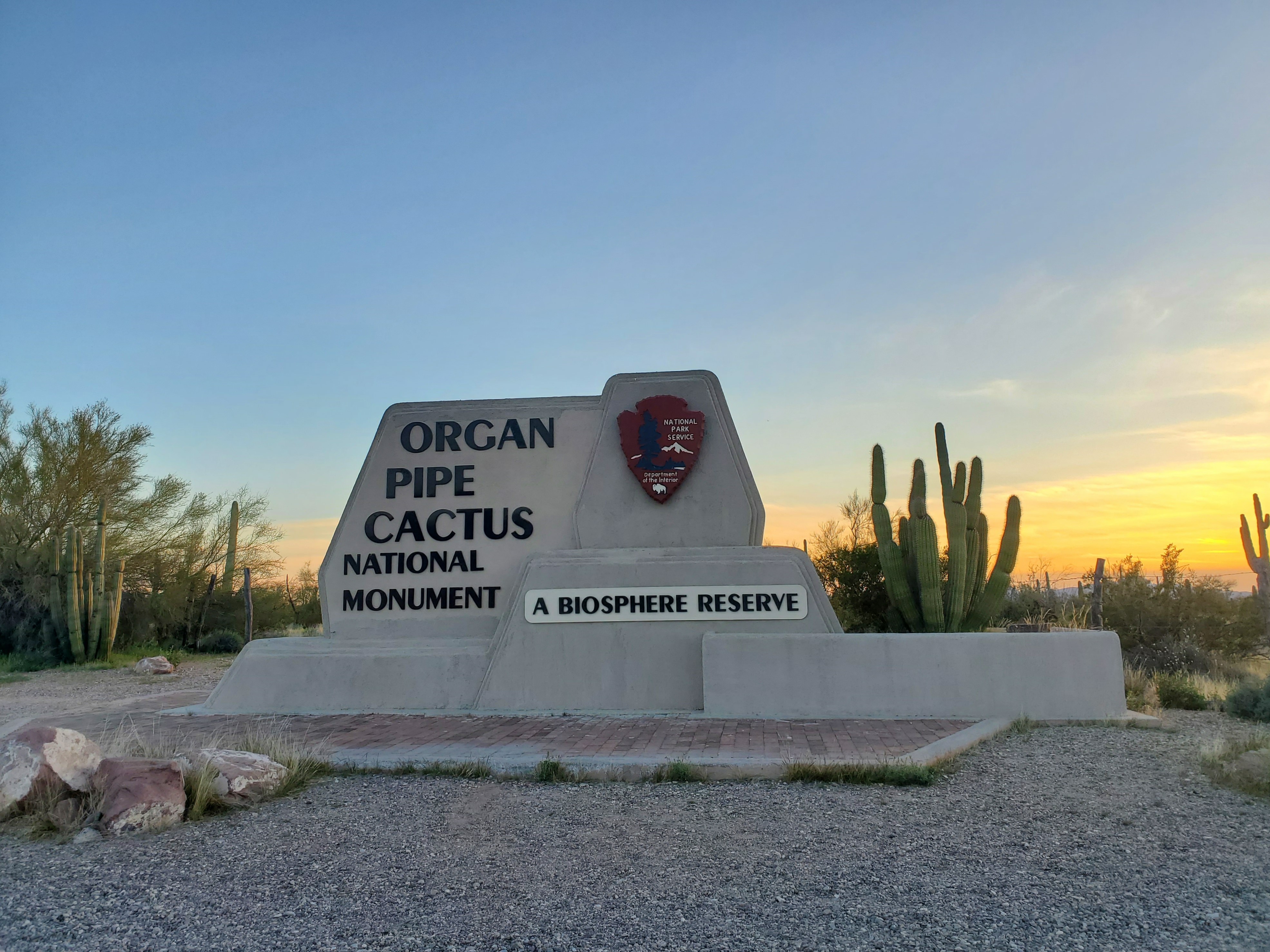 |
| Our last stop was at the entrance to the Monument as the sun was slowly setting in the West. |
In the late 1960s, a biosphere reserve program was conceived by the United Nations Educational, Scientific And Cultural Organization (UNESCO) as one solution to the seemingly overwhelming environmental pressures confronting the world. The reserves would conserve samples of the world's ecosystems such as a tropical forest, prairie grassland, coral reef, river system, or desert. In 1971 the Man and the Biosphere Program (MAB) was started with the intention to test and outline how humans can strike a balance among the apparently conflicting issues of conserving biological diversity, promoting economic and social development, and maintaining associated cultural values. Scientists from 83 nations supervise the MAB program involving over 325 reserves, including 56 in the United States.
The Organ Pipe Cactus Biosphere Reserve
The Organ Pipe Cactus Biosphere Reserve is a first-generation biosphere reserve created in 1976 for the conservation of the unique resources representing a pristine example of an intact Sonoran Desert ecosystem. The biosphere designation has helped to attract scientists from around the world to Organ Pipe Cactus to conduct a variety of important studies to help us better understand the Sonoran Desert and the impact of humans on this amazing landscape.
As the move forward into the future, Organ Pipe Cactus National Monument will be working closely with surrounding land agencies and stakeholders, including the Tohono O'odham Nation, The Bureau of Land Management, Cabeza Prieta National Wildlife Refuge and the local communities to further the ideas of the biosphere program by promoting expanded research, education, tourism and recreational facilities.
Individual Biosphere Reserves remain under the sovereign jurisdiction of the countries in which they are situated. Organ Pipe Cactus National Monument remains under the management and authority of the United States National Park Service. (Information from the Organ Pipe Cactus National Monument Website)
The Ajo Mountain Drive is well worth the time. It is 21 miles and estimated it will take 2-3 hours; the time really depends how many times you stop and take a walk. There are a couple of picnic areas provided along the way. The only vehicle restriction I found for this ride was the vehicle could not be longer then 25ft. We have seen small motorhomes on this drive. They provide a Guide at the Visitor Center which includes information about the numbered spots along the way.
The Puerto Blanco Drive is 41 miles and the estimated time is 3-4 hours; again it depends how much you stop and get out and walk. They do recommend a high clearance vehicle for this drive.
We have taken the Ajo Mountain Drive several times and would not hesitate to take it again in the future.
We took the Puerto Blanco Drive one time back in March of 2018 if you are interested about some of the views on this ride click here. There are a couple of pictures of what the fence looked like back then in the post. For us taking this entire drive once was enough. We did start at the end this year and drive in and take the road into the Senita Basin. Never say never but I am not sure we would do any part of this drive again. Though we are glad we took the time this year and in the past.
The Organ Pipe Cactus National Monument is beautiful and in our opinion it is well worth the visit.
.jpg) |
| Yes, I know I am a day late but I still wanted to say hello! |


